Ask One More Question


Someone brings you a problem.
They’ve learned not to simply ask, “What should I do?” Instead, they’ve thought about it. They’ve considered some options, and they come to you with a recommendation.
That’s exactly what we talked about in the last post.
But now comes another test of leadership.
What do you do with their recommendation?
The temptation is still there. We can say, “That will work,” or, “No, here’s what I think we should do.”
Either response gets us to a decision pretty quickly. And if you’ve been leading for a long time, you can probably get there faster than the person sitting across from you.
I know I can fall into that trap.
I grew up with a dad who expected me to learn how to do things. Hunting, fishing, working with my hands, figuring things out—Dad was always teaching me. He taught me to work hard, keep my word, and be self-reliant. Most of those lessons didn’t come from sitting me down and explaining some great philosophy of life. They came from doing things together and expecting me to learn along the way.
Later, the Army reinforced preparation, standards, accountability, and accomplishing the mission. Then I spent decades in professional leadership roles where people naturally looked to me to make decisions and solve problems.
Put all of that together and you get someone who is pretty comfortable solving problems.
Maybe a little too comfortable sometimes.
For years, I probably considered my ability to quickly see a solution one of my strengths as a leader. And to some extent, it is. Experience matters. You accumulate enough successes, failures, and hard-earned lessons that you begin recognizing patterns pretty quickly.
But I’ve also come to realize there’s a difference between being capable of solving the problem and needing to be the person who solves it.
That’s a distinction I’m paying much more attention to these days.
Proverbs 18:13 says:
“To answer before listening—that is folly and shame.”
I’ve been thinking about that verse differently lately.
It’s not just about being polite enough to let someone finish talking. For me, it’s also a reminder not to start solving the problem in my head before I’ve really understood how the other person sees it.
That can be difficult when experience tells you that you already know the answer.
Maybe the better response is to slow down and ask one more question.
Curiosity Before Correction
Curiosity has become an intentional part of my daily leadership routine.
When someone proposes something I disagree with, my natural instinct can be to explain why I think there’s a better approach.
I’m trying to change that.
Instead of saying, “That won’t work,” I’m trying to ask:
“Walk me through how you got there.”
Or one of my favorites:
“What am I missing?”
That second question requires some humility.
Because maybe I am missing something.
The person sitting across from me may be closer to the situation than I am. They may have information I don’t have. They may have considered something I haven’t.
Or maybe their solution is simply different from mine.
Different doesn’t automatically mean wrong.
So I’m trying to practice something simple:
Curiosity before correction.
Ask why.
Ask what could go wrong.
Ask who else might be affected.
Ask what alternatives they considered.
Ask what success would look like.
You don’t need to ask all of them. This isn’t an interrogation, and the person sitting across from you shouldn’t feel like they’re defending a dissertation.
Sometimes one good question is enough.
“What could go wrong?”
Then be quiet.
Let them think.
There’s a reason the Socratic method has endured for centuries. A good question forces the learner to do the thinking.
You may watch someone pause and eventually say, “I hadn’t thought about that.”
That’s a powerful moment.
You didn’t tell them what they missed.
They discovered it.
And that’s where judgment starts to develop.
A good question doesn’t just uncover an answer. It teaches someone how to think.
There’s another side of this that I’m learning too.
Sometimes I ask a question expecting the other person to eventually arrive at the answer already sitting in my head.
That’s not really coaching.
That’s a guessing game.
If there’s only one acceptable answer because of safety, ethics, policy, finances, legal requirements, or another legitimate constraint, I should be clear about it.
Tell them the guardrail. Explain why it exists. Teach the lesson.
But when there really is room for judgment, I need to give them room to use it.
And occasionally, something happens that experienced leaders need to be willing to admit:
Their answer is better than mine.
That’s a good thing.
If I ask a question and discover something I hadn’t considered, leadership development just happened on both sides of the table.
Maybe that’s part of the lesson too.
Leadership experience should give us better questions—not just faster answers.
The progression we’ve been talking about throughout this series is starting to take shape.
At first, someone comes to you and says:
“What should I do?”
Eventually, it becomes:
“Here’s what I recommend.”
And now we’re trying to get to:
“Here’s what I recommend, and here’s why.”
That last part matters.
Because leadership isn’t simply about reaching the right answer. It’s about developing the judgment necessary to make good decisions when the answer isn’t obvious.
I can share my experience. I can provide context. I can establish guardrails and challenge assumptions.
But eventually, they have to think.
And sometimes that means I have to deliberately keep the answer in my head and ask another question instead.
I’m still working on that.
Probably always will be.
A Question for Leaders
Think about your conversations this week.
When someone brings you an idea or recommendation you don’t immediately agree with, what happens next?
Do you explain your answer?
Or do you get curious about theirs?
This week, try something simple.
Before giving your opinion, ask one more question.
Then listen.
You may help someone discover something they hadn’t considered.
You might discover something you hadn’t considered either.
And somewhere in that conversation, both of you may become better leaders.
Developing someone else requires being willing to be developed yourself.
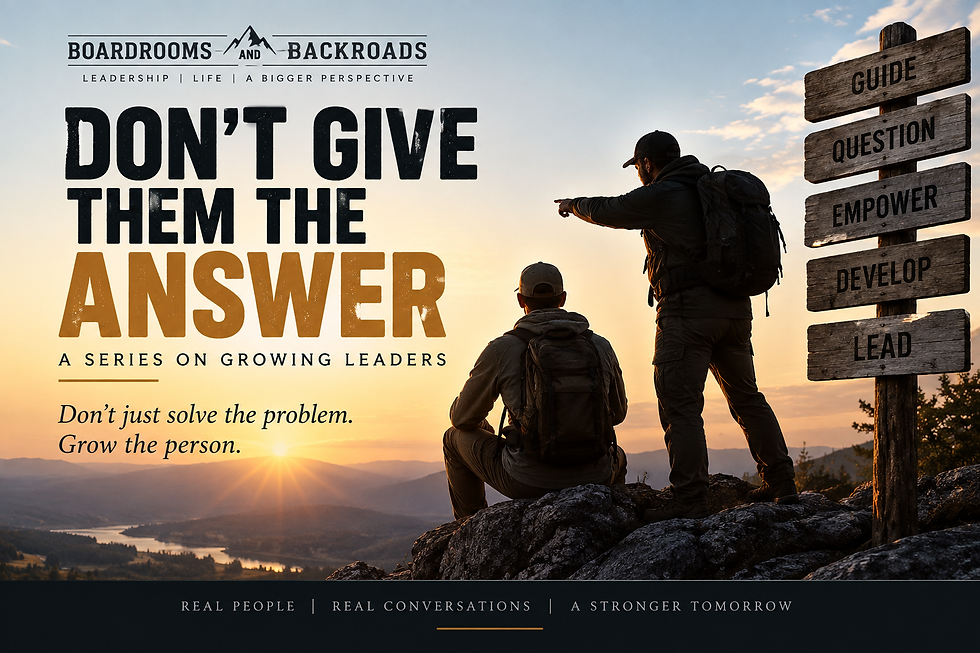
Don’t just solve the problem. Grow the person.
Go Be The Reason.


Comments